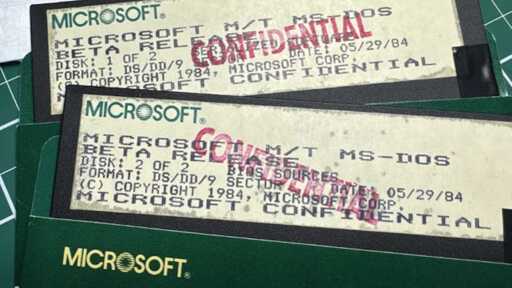
“Bic Pen” just released the dark secrets of the medieval “quill”.
I owned a copy of MS-DOS 1.0. The source code listing was included in the back of the manual.
This is a very ass-kissy M$ article. Love the “m$ continues to embrace open source”. Yeah you can tell because they open the code to their software many decades after it is completely obsolete.
What exactly were you expecting? Should they opensource Windows 11?
No. They should burn it.
Edgy
Yes.
Yes, unironically. It’d eliminate most security risks currently inherent to Windows while allowing for decent customization. It would also greatly accelerate WINE and ReactOS, giving legacy software a smooth offramp from insecure older versions of windows to Linux.
But until they were all patched, they’d all be exploitable
they already are
I’d expect the author of this article to understand what the word embraced means to start with. If this is m$ embracing OS, it’s akin to seeing two people shake hands and shouting “OMG they’re fucking!”
“omg they’re fucking”
A spokesperson said that the only reason they didn’t open source Windows 3.0 and Windows 3.11 for Workgroups at the same time was that it was still in use for some highly critical systems.
/s //Probably
3.11 is still used by Deutsche Bahn for display systems.
Most german thing I’ve heard today
Nah. Having worked in the industry - we built (the) Unix and a Linux distro, and I helped secure it - I can absolutely confirm older OSes are being used for very crucial stuff in an ironic mix of risk and safety that is bizarre.
Hint: Big grey-blue boats with numbers and famous names on the side.
Inside a janitors closet, behind 24 firewalls, is a single SPARCStation serving the internal financial information for GE.
A single chair is in the converted closet for Hank to sit when they (it could be one person, or three working in shifts, no one is really sure. But they respond to “Hank”) aren’t putting out the most recent fire. The pile of used extinguishers are replaced daily. Hank likes his job. Hank doesn’t like you. If you’re lucky enough and get access through the 7 biometrically locked doors to exchange the extinguishers, it’s been said you can hear mumblings from inside the closet about “uptime”.
On September 30th, 2018, John Flannery, the CEO at the time, asked why this was all necessary and considered replacing this system with something more modern.
"I joke with people and say it’s the Air Force’s oldest IT system. But it’s the age that provides that security,” Rossi said in an October interview. “You can’t hack something that doesn’t have an IP address. It’s a very unique system — it is old and it is very good.”
In 2016, the Government Accountability Office wrote that SACCS runs on an IBM Series/1 computer dating from the 1970s and that the Defense Department planned “to update its data storage solutions, port expansion processors, portable terminals and desktop terminals by the end of fiscal year 2017,” but it’s unclear whether those upgrades have occurred.
Like, names of presidents? Dude.
I bet there’s a not insignificant chunk of Win3.11 code still lurking at the heart of Windows even now. Patched and recompiled for 64 bits, but still there.
Though most of it is probably for backwards compatibility by this point. Or so we should hope.
If you go deep enough, there’s still windows 3.11 dialog boxes in Windows 11 for some core functionality.
Windows 11 is finally a mature operating system that most people would be happy to use.
NOPE.
I last had to use the ODBC data sources file picker in 2016, so about ten years ago, in Win7. Completely forgot how much of a drag it was.
An interesting assertion. A full install of 3.11 was about 8 MB or so, and all of the 8086 / -186 / -286 / -386 code will have been thrown away a long time ago. I doubt there’s much of PROGMAN left, and all the fonts and art assets are long superseded. So in terms of total code, it can’t be much. But on the other hand, the code that you write for an event loop or to handle driver interrupts hasn’t changed conceptually very much in that time. Most programmers would reimplement the basics in a very similar way, so there’s not much point in redoing it.
When I used to work in the water industry, we still had programmable logic controllers (PLCs) controlling pumpsets from the 1950s. The last person that could have modified them had retired and since died more than 30 years before. But deciding which pumps to run in order to best fill a reservoir is not logic that needs updating every day, not even every decade. Still working fine, don’t touch it. So I still laugh at my colleagues that can’t touch code that was written a few years ago in an unfashionable library. That’s not tech debt. Try, written by your grandparents for CPUs that had stopped being made before you were born.
And I remember 3.11 being perfectly good enough at the time, anyway. Wasn’t any Linux at that point.
I’ve got equipment in the field thats from the early 90s. I imagine there’s plenty of computer driven shit that just works so never gets replaced.
The best part about shit that age is you can easily fix shit with some electronics or engineering skills.
😬
Microsoft explained, “These materials aren’t just operating system releases in the traditional sense. In several cases, the listings represent point‑in‑time working states and hand-written notes, preserved by Tim Paterson himself. Think of them as a printed commit history of a Git repository.”